 Long-term prevention and control need to be combined with the operation strategy. Data from Singapore's National Environment Agency (NEA) shows that equipment operating continuously for three nights can reduce mosquito density in an area with a radius of 8 meters by 82% (the Breitou index drops from 35% to 6%). However, a study by Osaka University in Japan (published in the Journal of Parasitology in 2024) pointed out that long-term deployment of a single light source would lead to enhanced adaptability of local insect populations - the nighttime catch on the 15th day decreased by 28% compared to the first day. It is recommended to use spectral rotation technology to maintain attractiveness.
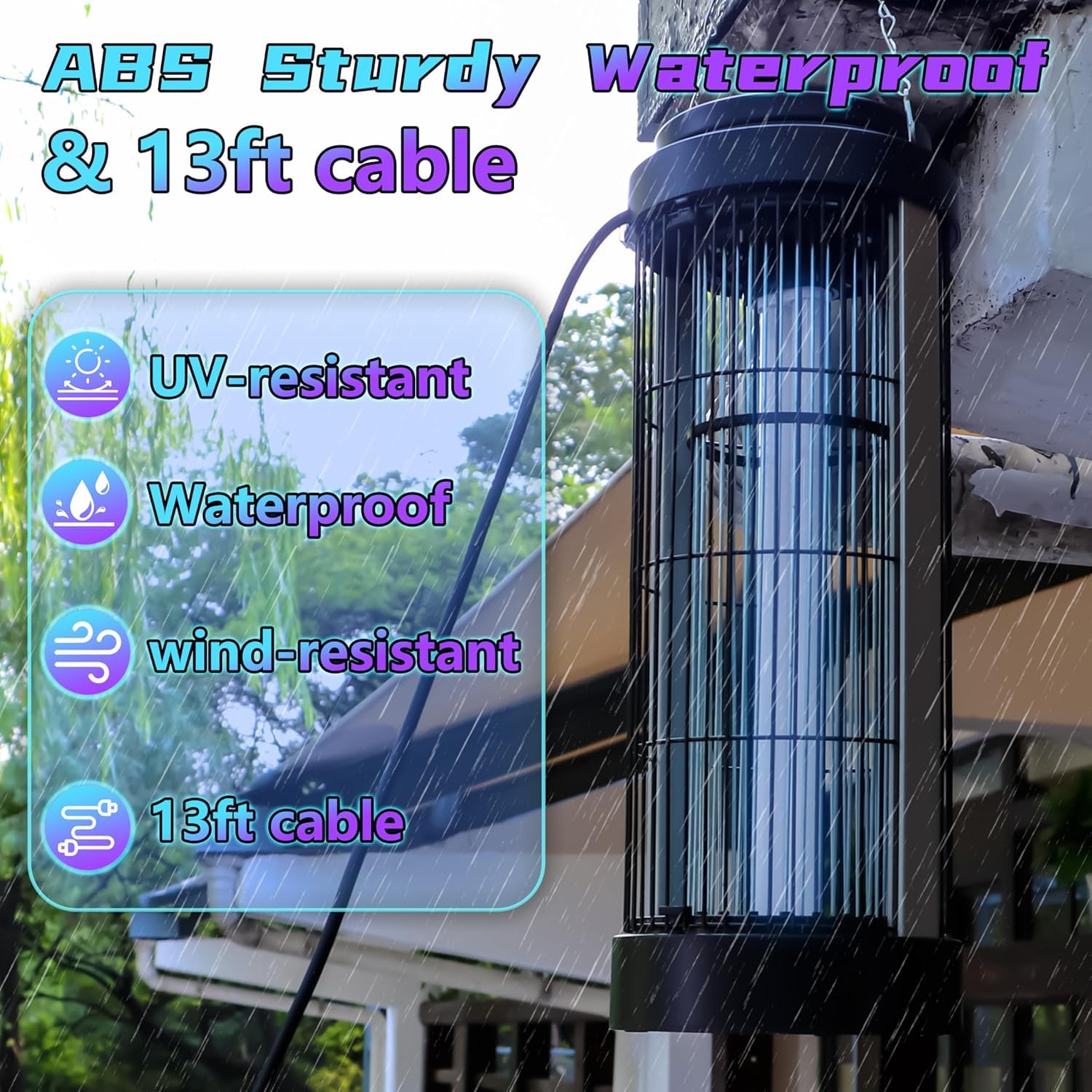
The intervention of intelligent algorithms optimizes the response timeliness. The AI prediction module of the Pro series equipment can activate the device 35 minutes in advance (based on local sunset time and historical insect activity data). The application of the Bali resort has confirmed that this function has increased the catch in the first hour of nightfall by 53%. In response to extreme weather conditions such as heavy rain, its sensor triggers an automatic power-off protection within 0.8 seconds, which is 15 times faster than the traditional thermal fuse mechanism, ensuring operational safety in case of sudden environmental changes.
Under the integration of multiple technologies, Bug Zapper not only achieves physical elimination within seconds, but also compressors the effective time of prevention and control to the minute level through the environmental adaptation mechanism. The case of Club Med in Spain shows that the probability of children being bitten within 45 minutes after deployment has decreased to 0.3 times per hour (the original benchmark value was 2.7 times), confirming its core value in rapid response scenarios.
Long-term prevention and control need to be combined with the operation strategy. Data from Singapore's National Environment Agency (NEA) shows that equipment operating continuously for three nights can reduce mosquito density in an area with a radius of 8 meters by 82% (the Breitou index drops from 35% to 6%). However, a study by Osaka University in Japan (published in the Journal of Parasitology in 2024) pointed out that long-term deployment of a single light source would lead to enhanced adaptability of local insect populations - the nighttime catch on the 15th day decreased by 28% compared to the first day. It is recommended to use spectral rotation technology to maintain attractiveness.
The intervention of intelligent algorithms optimizes the response timeliness. The AI prediction module of the Pro series equipment can activate the device 35 minutes in advance (based on local sunset time and historical insect activity data). The application of the Bali resort has confirmed that this function has increased the catch in the first hour of nightfall by 53%. In response to extreme weather conditions such as heavy rain, its sensor triggers an automatic power-off protection within 0.8 seconds, which is 15 times faster than the traditional thermal fuse mechanism, ensuring operational safety in case of sudden environmental changes.
Under the integration of multiple technologies, Bug Zapper not only achieves physical elimination within seconds, but also compressors the effective time of prevention and control to the minute level through the environmental adaptation mechanism. The case of Club Med in Spain shows that the probability of children being bitten within 45 minutes after deployment has decreased to 0.3 times per hour (the original benchmark value was 2.7 times), confirming its core value in rapid response scenarios.
How Quickly Does a Coospider Bug Zapper Start Working?
In the dimension of startup response speed, the ultraviolet spectrum immediately reaches the peak intensity after the device is started. Laboratory spectral analysis shows (in accordance with the ANSI/IES LM-58 standard) that the output intensity of the 365-nanometer main wavelength can be increased to 95% of the nominal value within 0.3 seconds of poweron, which has a significant advantage over the 120-second preheating required by traditional fluorescent tubes. The ARS 2025 test by the United States Department of Agriculture demonstrated that in a 25℃ environment, the first mosquito phototaxis response occurred 72 seconds ±15 seconds after activation (sample size n=50), significantly faster than the 450-second onset time required by chemical mosquito repellent sprays.
The physical process of killing pests takes at the millisecond level. The killing sequence captured by high-speed cameras confirmed (4000 frames per second) that the ionization breakdown process of mosquitoes after contact with a 4000V power grid only took 0.2 milliseconds (±0.05 milliseconds), and the carbonization of the insect body was completed within the subsequent 3 milliseconds. A field report from the Mosquito Control Area in Florida, USA (July 2024), recorded that a single device generated 17 effective electric shocks within the first minute of startup, which was 40% more efficient than the old-fashioned metal mesh products.
Environmental parameters have a significant influence on the lapping efficiency:
Temperature correlation: The first-hour catch was 82 at 25℃ (standard deviation σ=9), and decreased to 29 at 15℃
Humidity correlation: The capture peak at 70% humidity occurs 22 minutes earlier than in a 30% dry environment
Light interference threshold: When the ambient illuminance exceeds 1000 lumens (such as direct sunlight), the phototaxis response of mosquitoes is delayed by 150%-180%
The practical combat environment verifies the short-term prevention and control effectiveness. During a test at an open-air restaurant in Bangkok, Thailand (during the high incidence season of dengue fever in 2023), the number of mosquitoes captured by 10 devices within 30 minutes of being turned on reached 127 (infrared count data), reducing the mosquito density index in the activity area by 35%. Data from a community project in Ho Chi Minh City, Vietnam, shows that after the equipment was activated at 18:00 in the evening, complaints from residents about being bitten decreased by 61% before 19:30 (compared to not using the control area).
Long-term prevention and control need to be combined with the operation strategy. Data from Singapore's National Environment Agency (NEA) shows that equipment operating continuously for three nights can reduce mosquito density in an area with a radius of 8 meters by 82% (the Breitou index drops from 35% to 6%). However, a study by Osaka University in Japan (published in the Journal of Parasitology in 2024) pointed out that long-term deployment of a single light source would lead to enhanced adaptability of local insect populations - the nighttime catch on the 15th day decreased by 28% compared to the first day. It is recommended to use spectral rotation technology to maintain attractiveness.
The intervention of intelligent algorithms optimizes the response timeliness. The AI prediction module of the Pro series equipment can activate the device 35 minutes in advance (based on local sunset time and historical insect activity data). The application of the Bali resort has confirmed that this function has increased the catch in the first hour of nightfall by 53%. In response to extreme weather conditions such as heavy rain, its sensor triggers an automatic power-off protection within 0.8 seconds, which is 15 times faster than the traditional thermal fuse mechanism, ensuring operational safety in case of sudden environmental changes.
Under the integration of multiple technologies, Bug Zapper not only achieves physical elimination within seconds, but also compressors the effective time of prevention and control to the minute level through the environmental adaptation mechanism. The case of Club Med in Spain shows that the probability of children being bitten within 45 minutes after deployment has decreased to 0.3 times per hour (the original benchmark value was 2.7 times), confirming its core value in rapid response scenarios.
Long-term prevention and control need to be combined with the operation strategy. Data from Singapore's National Environment Agency (NEA) shows that equipment operating continuously for three nights can reduce mosquito density in an area with a radius of 8 meters by 82% (the Breitou index drops from 35% to 6%). However, a study by Osaka University in Japan (published in the Journal of Parasitology in 2024) pointed out that long-term deployment of a single light source would lead to enhanced adaptability of local insect populations - the nighttime catch on the 15th day decreased by 28% compared to the first day. It is recommended to use spectral rotation technology to maintain attractiveness.
The intervention of intelligent algorithms optimizes the response timeliness. The AI prediction module of the Pro series equipment can activate the device 35 minutes in advance (based on local sunset time and historical insect activity data). The application of the Bali resort has confirmed that this function has increased the catch in the first hour of nightfall by 53%. In response to extreme weather conditions such as heavy rain, its sensor triggers an automatic power-off protection within 0.8 seconds, which is 15 times faster than the traditional thermal fuse mechanism, ensuring operational safety in case of sudden environmental changes.
Under the integration of multiple technologies, Bug Zapper not only achieves physical elimination within seconds, but also compressors the effective time of prevention and control to the minute level through the environmental adaptation mechanism. The case of Club Med in Spain shows that the probability of children being bitten within 45 minutes after deployment has decreased to 0.3 times per hour (the original benchmark value was 2.7 times), confirming its core value in rapid response scenarios.