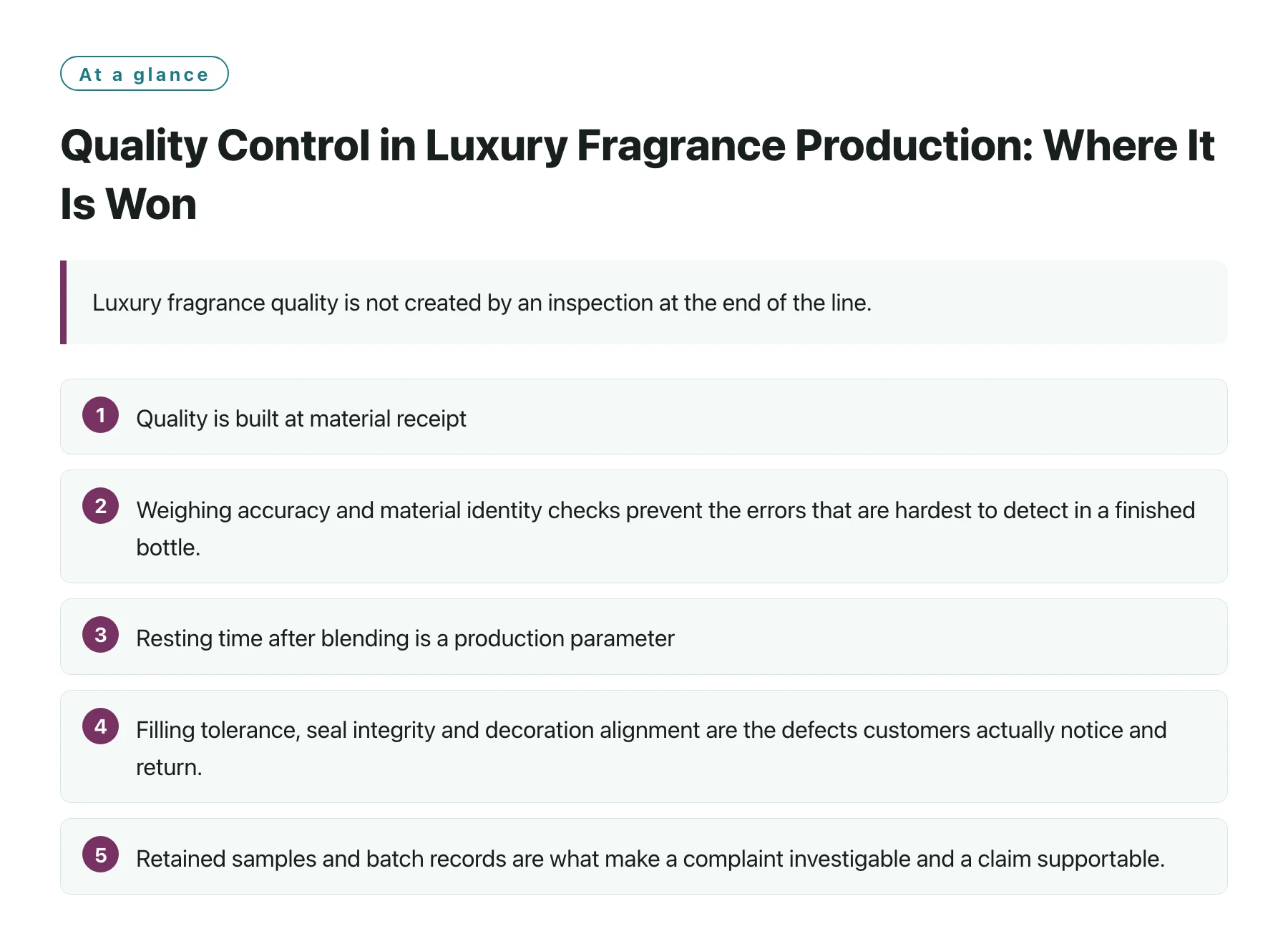
Luxury fragrance quality is not created by an inspection at the end of the line. It is created by a series of small disciplines that start with incoming materials and end with a retained sample, and every one of them is boring on its own. What separates a consistent product from an inconsistent one is whether those disciplines are documented, repeated and auditable. This article sets out the control points that matter and how a buyer can check them without standing on the factory floor.
Key takeaways
- Quality is built at material receipt, weighing and resting, not at final inspection.
- Weighing accuracy and material identity checks prevent the errors that are hardest to detect in a finished bottle.
- Resting time after blending is a production parameter, and cutting it changes what the customer smells on day one.
- Filling tolerance, seal integrity and decoration alignment are the defects customers actually notice and return.
- Retained samples and batch records are what make a complaint investigable and a claim supportable.
Ask a brand what quality control means and you usually hear about testing. Ask a production manager and you hear about documentation, calibration and the sequence of checks that happen before a bottle is ever filled.
The difference matters because the failures that damage a premium product are rarely analytical. They are a cap that does not sit flush, a fill that varies across a carton, a batch that went out three days early because the schedule was tight, a label printed with the previous revision of the ingredient list.
This article describes the control routine in the order it actually runs, then sets out how a brand can verify it during supplier qualification and after each batch.
The control points, in the order they occur
A fragrance travels through a predictable sequence: materials arrive, a batch is weighed and blended, the blend rests, it is filtered and filled, the pack is assembled and decorated, and the finished goods are inspected and stored. Each stage has one or two controls that catch most of the errors.
Looking at them in sequence is more useful than listing them, because the controls are designed to be cheap at the front and expensive at the back. A material misidentified on receipt costs a phone call; the same error discovered in a filled bottle costs the batch.
Incoming materials and identity checks
Every delivery should be checked against the specification and the approved supplier, with a retained sample of the incoming lot. Identity confirmation matters most for materials that are visually similar or supplied in similar packaging.
A documented incoming check also protects the manufacturer commercially. Without it, a material fault becomes indistinguishable from a production fault several weeks later.
Weighing, blending and resting
Weighing is the point where a formula becomes a batch, and it is where small errors become permanent. Calibrated scales, a second-person check on restricted or high-impact materials, and a record of actual weights rather than target weights are the useful controls.
Resting after blending is the stage most often compressed under schedule pressure. A blend that is filled immediately behaves differently from one that has rested, particularly in the opening. The resting period should be a written parameter of the product, not a variable that the planner can trade away.
Filling, sealing and decoration
Fill volume tolerance, pump or cap torque, seal integrity and label alignment are the defects a customer can see without any technical knowledge. They should be checked against a written standard at defined intervals through the run, not only at the start and the end.
For premium products, decoration defects deserve their own inspection step, because a coating, hot stamp or screen print that is slightly off is the most visible possible defect and the least likely to be caught by weight or volume checks.
The single most useful quality document in fragrance production is not an analytical report. It is the retained sample with its batch number, date and storage condition. Everything else can be reconstructed; the physical reference cannot. If a supplier cannot show you a retained sample from a previous batch, you have no way to establish whether a current batch has drifted, and no basis for a complaint that will survive scrutiny. Ask to see one during supplier qualification, ask how long they are kept and where, and make retention a written term of the supply agreement rather than a habit that depends on who is on shift.
Control points, typical failure, and how a buyer can verify
| Control point | Failure it prevents | Evidence to request | Who owns it |
|---|---|---|---|
| Incoming material check | Wrong or off-spec material entering production | Specification sheet and retained incoming sample | Quality and warehouse |
| Weighing record | Formula deviation that is invisible in the bottle | Signed batch record showing actual weights | Production and quality |
| Resting period | A scent that reads differently at launch | Written parameter and time-stamped batch log | Production planning |
| Fill and seal check | Variance across a carton and leaks in transit | In-process check sheet with frequencies | Production quality |
| Decoration inspection | Visible defects on a premium pack | Defect standard and inspection records | Packaging quality |
| Retained samples | Complaints that cannot be investigated | Sample storage log with retention period | Quality assurance |
Read the third column as a shopping list. Each item can be requested by email before an order is placed, and each one tells you something about how the plant operates. A supplier that can produce all six quickly is running a system; one that can produce two is running on the experience of its staff, which is a different and more fragile kind of assurance.
Systems, testing and what each one proves
Two kinds of assurance are often confused. A management system certificate says that a plant operates a defined process and is audited against it. A test report says something specific about a specific sample.
Both are useful, and neither replaces the other.
Certified systems describe the process
Cosmetics good manufacturing practice standards such as ISO 22716 describe how production should be organised, documented and controlled, and independent testing and certification bodies offer audits against them [1]. A certificate is evidence that a process exists and has been reviewed, not evidence about your particular batch.
Ask which systems the plant operates and when the last audit was. That is a reasonable qualification question and an unreasonable thing to discover after a defect.
Material restrictions shape what can be produced
Restriction standards published by the International Fragrance Association define how much of a given material may be used in each product category [2]. In a quality system this becomes a control: the formula is checked against the limits, and the check is recorded with the batch.
When the check is recorded, reformulation risk becomes visible. A formula that passed with little headroom is a formula that will need attention when either the restriction or the product brief changes.
Technical practice is documented in the trade press
Cosmetics & Toiletries and similar technical publications cover formulation and testing practice in detail, including how stability and compatibility work is structured [3]. Reading a couple of articles is a fast way for a brand-side manager to learn which questions are reasonable to ask.
The point is not to become a formulator. It is to be able to tell a substantive answer from a reassuring one.
That is also the right frame for quality control in luxury fragrance production: you are buying a documented routine that repeats on every batch, not a promise attached to a single test report. Ask what happens on a Friday afternoon when the schedule is behind, because that is when a system is either present or absent.
How to qualify a manufacturer on quality, not on reputation
- Request the certificate list before the quotationAsk which management systems are certified and when they were last audited, and expect a specific answer.
- Ask to see a batch recordA completed record shows what is actually written down during production, which is more informative than a blank template.
- Inspect the retained sample practiceConfirm that samples are kept per batch, labelled, and stored under defined conditions for a stated period.
- Define the reference standard in the contractName the approved sample, the tolerance and the comparison method that will be used to judge future batches.
- Agree the defect standard for packagingWritten limits for fill, alignment and surface defects remove most arguments about what counts as acceptable.
- Audit after the second order, not before the firstA visit once there is real product history reveals more than a tour during the sales process.
Sources
- SGS: Cosmetics, Personal Care & Household Testing —— Testing, inspection and certification services for cosmetics and personal care, including microbiological, stability and safety testing aligned with cosmetics GMP.
- IFRA Standards Library (International Fragrance Association) —— The IFRA Standards Library lists the restrictions the fragrance industry applies to individual fragrance ingredients, based on safety assessments; it is the reference point for compliant fragrance formulation.
- Cosmetics & Toiletries —— A technical magazine for cosmetic formulators, covering ingredients, formulation science and testing methods.
Frequently asked questions
What does quality control cover in fragrance production?
It covers incoming material checks, weighing and blending accuracy, resting time, filtration, filling and sealing tolerance, packaging and decoration inspection, retained samples and batch documentation. Testing is one part of that sequence, and it is usually the smallest part.
How do I verify a perfume factory's quality claims?
Request its certificate list and last audit date, a completed batch record, and evidence of retained samples with batch numbers and storage conditions. Then define the approved reference standard and the packaging defect limits in the supply agreement, so future batches are judged against something written down.
Why is resting time important after blending?
A freshly blended formula behaves differently from one that has rested, most noticeably in the opening. If the resting period is shortened to meet a schedule, the product can smell different from the approved sample even though the formula and materials are unchanged.
Is a GMP certificate enough to guarantee batch consistency?
No. A certificate shows that a documented process exists and has been audited. Consistency comes from whether that process is followed on every batch, which is why batch records, retained samples and in-process checks are the more direct evidence.
What should I do if a bulk batch does not match the approved sample?
Compare it against the retained reference from the same batch and against the approved standard, and ask for the batch record covering weights and resting time. If the reference and the bulk differ, the issue is production; if the reference itself has moved, the issue is the formula or the materials.