Before You Buy a 50 TH/s Miner, Count the Years
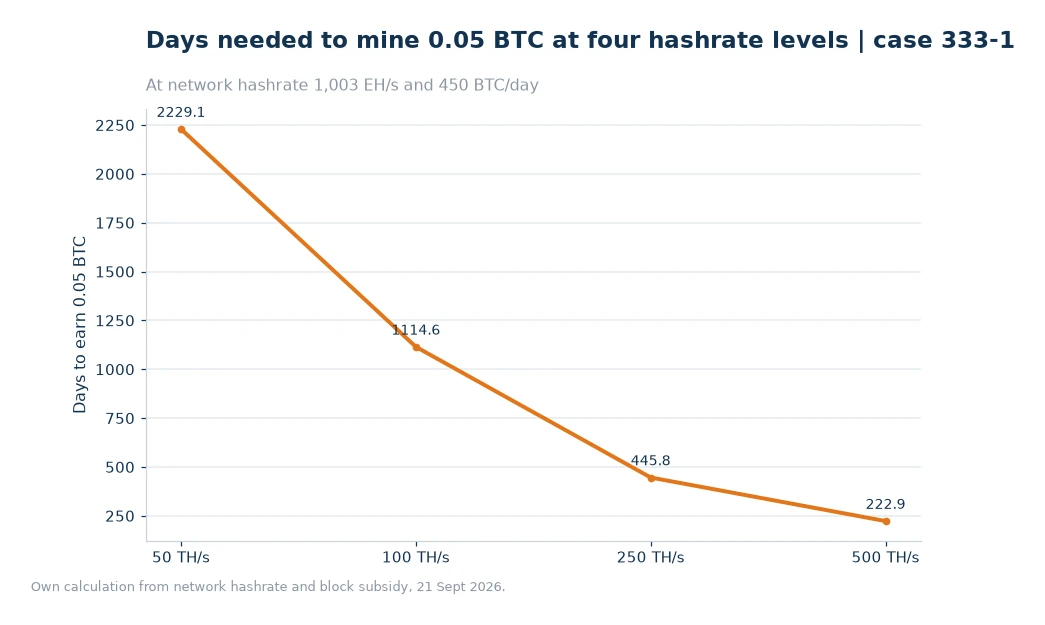
Small miners are sold on watts and noise, and almost never on the time it takes to produce a meaningful amount of coin. At 50 TH/s, 0.05 BTC takes about 2,229 days at the 21 Sept 2026 network figures — six years and a bit. The same target takes 222.9 days at 500 TH/s. That gap, not the sticker price, is the real difference between the two purchases.
Key takeaways
- 50 TH/s needs roughly 2,229 days, or 6.1 years, to produce 0.05 BTC at current network figures.
- The same target takes 1,114.6 days at 100 TH/s, 445.8 at 250 TH/s and 222.9 at 500 TH/s.
- Annual output at 50 TH/s is about 0.008187 BTC, which is $693 at $84,692 per BTC.
- If the hardware's useful life is shorter than the target's timeline, the purchase is a bet on resale rather than on mining.
The number the listing never prints
A product page will tell you the hashrate, the power draw, the noise level and sometimes the chip process. It will not tell you how many years of continuous operation are needed to accumulate a specific amount of coin, because that number depends on the network and changes every difficulty adjustment. It is still the number a buyer needs, and it can be computed in one line.
Buyers who skip the line tend to compare machines by price per terahash. That is a reasonable first filter and a poor final one, because two rigs with the same price per terahash can have very different power efficiency, and power is the cost that continues after the purchase is forgotten.
There is also a habit of mind worth naming. A listing quotes a hashrate, and the buyer silently converts that into "a miner". The conversion hides scale. Fifty terahashes is a small fraction of a single petahash, and a petahash is a thousandth of an exahash, and the network is a thousand exahashes. Written as a fraction, the machine's share of the whole network is about one in twenty million, which is a clearer picture of what it is buying than any badge on the box.
None of this is an argument against small machines. It is an argument for buying them with open eyes, and for treating the timeline as part of the specification. A buyer who knows the wait can decide whether the wait is acceptable. A buyer who does not know it has delegated that decision to a marketing page.
Six years is longer than most hardware lives
At 50 TH/s the wait for 0.05 BTC runs past six years. Fans, power supplies and thermal paste do not usually last that long without attention, and the machine will be worth very little at the end of it. A purchase plan that requires six years of uninterrupted service is really a plan to keep replacing parts while the target stays roughly where it was.
That does not make small miners useless. It makes them suited to a different goal: learning the workflow, using otherwise wasted power, or heating a room in winter while producing a little coin. The mistake is buying one for accumulation and expecting the calendar to behave like the larger machine's calendar.
A useful sanity check is to price the machine's output over its plausible service life rather than over the target's timeline. Three years at 0.008187 BTC a year is roughly 0.0246 BTC, or about $2,080 at $84,692. If the rig, its power supply and its shipping came to more than that, the purchase only works if the coin price rises or the machine is resold — and both of those are assumptions, not arithmetic.
Four purchase sizes on one timeline
The table reads the same curve four ways, adding a yearly output column because that is the figure to hold against a power bill. The yearly numbers are gross and ignore the listed fee, which is small at these scales but not zero.
| Hashrate | Days to 0.05 BTC | Years | BTC per year | USD per year |
|---|---|---|---|---|
| 50 TH/s | 2,229.1 | 6.1 | 0.008187 | $693 |
| 100 TH/s | 1,114.6 | 3.1 | 0.016374 | $1,387 |
| 250 TH/s | 445.8 | 1.2 | 0.040935 | $3,467 |
| 500 TH/s | 222.9 | 0.6 | 0.081870 | $6,934 |
Worked example
Work in petahashes this time, because the network total divides neatly that way and the small machine becomes a decimal instead of a long row of zeros.
- The network is about 1,003 EH/s, which is 1,003,000 PH/s.
- Network output per PH/s per day: 450 ÷ 1,003,000 = 0.00044865 BTC.
- 50 TH/s is 0.05 PH/s, so daily output is 0.05 × 0.00044865 = 0.00002243 BTC.
- Days to 0.05 BTC: 0.05 ÷ 0.00002243 = 2,229.2, matching the chart's 2,229.1 within rounding.
- Over a year: 0.00002243 × 365 = 0.008187 BTC.
- At $84,692 per BTC, that year is worth $693.30 — before power, cooling and any replacement part.
- The 500 TH/s machine is ten times larger, so its year is 0.081870 BTC, or $6,933.90, and its wait is a tenth as long.
Where Pool Luck enters the buying decision
Every figure above assumes the pool pays the average path. Under PPLNS it will not, exactly: payouts follow what the pool actually finds across the last five difficulty rounds, so a short window can land above or below the line. Pool Luck is the label for that deviation, and at small hashrates a miner feels it as a lumpy week rather than a smooth trickle.
PPS+ removes most of that lumpiness on the block-reward component by settling hourly against difficulty. For a buyer planning six years of accumulation, the scheme matters less than the network total, but for a buyer checking the first month's numbers it matters a lot. The ViaBTC Pool Hashrate view is the place to see how much hashrate the pool is carrying, which is also a rough guide to how quickly a PPLNS window fills.
One practical consequence for a small buyer: a PPLNS payout at 50 TH/s can arrive in uneven amounts, and a first-time miner may read that as a fault. It is not. The same machine under PPS+ would show a flatter series of hourly credits, and the annual total would sit close to the figures in the table above, since the listed rates differ by a couple of percentage points rather than by a multiple.
Frequently asked questions
Is a 50 TH/s miner worth buying at all?
It depends on the goal: at 50 TH/s the wait for 0.05 BTC is about 2,229 days, so the machine suits learning, spare power or space heating rather than fast accumulation.
What does the wait look like at 250 TH/s?
445.8 days for 0.05 BTC, with gross output of 0.040935 BTC a year, or about $3,467 at $84,692 per BTC before power costs.
Does a lower fee make a small miner viable?
A lower listed fee helps at the margin but cannot shorten a six-year timeline much; the dominating variables are hashrate, the network total and the price you pay for power.
Run the purchase test in three questions
First, how many days does your target take at the hashrate you are considering? Second, will the machine still be running and still be worth repairing when that day arrives? Third, what does a year of output sell for against a year of power at your tariff? A purchase that survives all three is a decision; one that fails the second question is a hobby with an invoice.
If the arithmetic leaves a gap, the Profit Calculator will price the daily output at current difficulty, and a Collateral-Pledged Loans arrangement is one way some operators bridge a hardware purchase — with the collateral and repayment terms doing the real work in that decision.
Sources: ViaBTC calculator, loan and pool state pages; network figures read 21 Sept 2026 — hashrate about 1,003 EH/s, difficulty 132.76 T, 3.125 BTC per block, 144 blocks a day, BTC $84,692. Published 24 Oct 2026. Timelines assume steady difficulty and continuous uptime[1].