Server Choice and Its Effect on a Crystal Order
A Genesis Crystal order is aimed at a character, not at a game, and the character lives on one of four servers: America, Europe, Asia or TW-HK-MO. The client's page lists all four, and the choice is the single detail most likely to stop an order, because the top-up is delivered by signing into the HoYoverse account and buying in the shop that account actually plays in. Everything else about the purchase — the pack, the price, the delivery window — is the same whichever server you pick.

Key takeaways
- Supported servers as published: America, Europe, Asia and TW-HK-MO.
- The order needs the account email, the password and the server the character plays on.
- One active session per account, so the account should be logged out while the order runs.
- Published delivery window for Genshin Impact: 5–30 minutes, 24/7, with longer queues right after a new banner.
Why the server field is not a formality
A top-up is not addressed to a username; it is addressed to an account on a server. The store signs in, opens the shop and buys the pack there, and the shop it opens belongs to the server that was named on the order. Name the wrong one and the purchase is attempted against an environment where the character you had in mind does not exist.
This is why the page asks for three things together rather than one. The email identifies the account, the password opens it, and the server disambiguates it. An email and password pair on their own are not enough to aim a purchase, and the server is the field that gets filled in from memory more often than from the game itself.
Checking it takes a moment and costs nothing. Open the game, look at the login screen, and note the server name exactly as the game writes it. Then compare that with the four on the store's list: America, Europe, Asia, TW-HK-MO. If the names match, the order is aimed correctly before any money moves.
The four servers, and what each order needs ready
The table below collects the published server list with the details that have to be in hand before payment. Every column comes from the client's own Genshin page; the notes are a summary of the same page's instructions rather than any added claim.
| Server | What to have ready | What the field decides |
|---|---|---|
| America | Account email, password, server name | Which account the shop purchase opens on |
| Europe | Account email, password, server name | Which world the crystals arrive in |
| Asia | Account email, password, server name | Which region the delivery targets |
| TW-HK-MO | Account email, password, server name | Which regional shop the pack is bought from |
Worked example: reading a discount off two published numbers
The server has no effect on price, and a short piece of arithmetic shows how the pricing works instead. The assumptions are the published prices on the Genshin page, where each pack is listed with a sale price beside a list price; the calculations are the author's.
Take the 300+30 pack. It is listed at $3.60 against a list price of $4.99, so the difference is $4.99 − $3.60 = $1.39. As a share of the list price that is $1.39 ÷ $4.99 = 0.279, or about 27.9% — which lines up with the 28% figure the store publishes for this title on its home page.
Now try the largest single pack. The 6480+1600 rung is listed at $74.99 against $99.99, a difference of $25.00, and $25.00 ÷ $99.99 = 0.250, or 25.0%. That is below the headline figure for the game, which is worth saying plainly rather than glossing over: the home page states one discount depth for the title, and individual packs carry their own pair of numbers. The pair beside the pack is the one that describes your order.
Run the same division on the smallest rung and the pattern continues. 60 Genesis Crystals are listed at $0.77 against $0.99, a difference of $0.22, and $0.22 ÷ $0.99 = 0.222, or about 22.2%. Three packs, three percentages, one published headline: 27.9%, 25.0% and 22.2% against a stated 28%. None of those figures is a promise about the next pack, and none of them changes because of the server you chose.
What the discount chart says about the game you picked
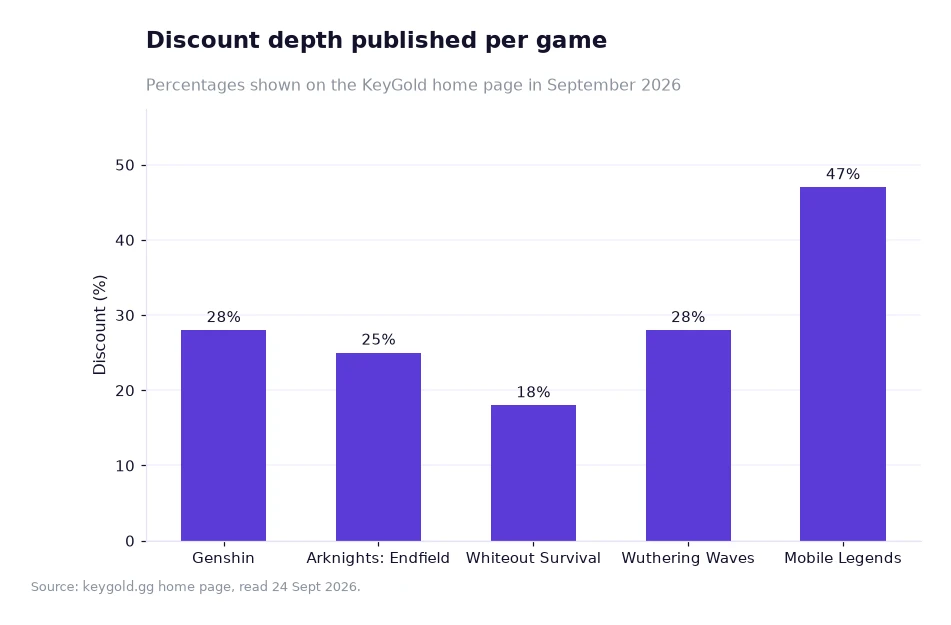
The chart draws the five headline figures from the home page side by side, and it is useful for two reasons. First, it places Genshin Impact at 28% next to Wuthering Waves at the same 28%, with Arknights: Endfield at 25%, Whiteout Survival at 18% and Mobile Legends at 47%. Second, and more importantly, it shows that the headline is a title-level summary: the values come from the home page, while the numbers that price an actual order come from the pack table on the game page.
That distinction is the reason the website's own pack listings are the better reference once you have chosen a title. A game-level percentage tells you roughly how the store prices that catalogue; the two figures printed beside a pack tell you what that pack costs. Buyers who want to compare across titles before deciding can browse the game list, where each title's page carries its own ladder, its own rating and its own published delivery window.
For anyone searching for a cheap genshin top up, the practical sequence is short: confirm the server in the game, open the game page, and read the two numbers beside the pack you want. The server list, the pack ladder and the delivery window sit on the same screen, which means the whole order can be checked in one pass rather than three.
Session rules while the order runs
The page states that one active session can be open per account, and it asks the buyer to stay logged out while the order is processed. That is a technical condition rather than a security one: two sessions on the same account interrupt each other, and a purchase interrupted mid-step does not complete. The practical version of the rule is to close the game before the order is placed and to leave it closed until the Order Record shows the purchase as finished.
The published delivery window for this title is 5 to 30 minutes, around the clock, with longer queues during the first hours of a new banner. That last detail is the one to plan around: a pack ordered on a quiet evening and a pack ordered minutes after a banner opens sit at opposite ends of the same published range. Planning the order for a calmer hour is the simplest way to land nearer the 5-minute end.
After delivery, the store signs out and clears the login history on its side, and the page advises changing the password and keeping two-step verification reachable, with any code sent only through the order chat. The Full Refund Guarantee covers an order that is not delivered or cannot be used, and the confirmation email arrives when the purchase completes.
Frequently asked questions
How do I know which server to select on the order?
Select the server your character actually plays on. The page lists the supported set as America, Europe, Asia and TW-HK-MO, and the order needs the account email, the password and that server name together, because the purchase is aimed at one account in one world.
Does the server change the price of a pack?
No. All four servers are served from the same published USD ladder on the store's Genshin page, and the home page states the title-level discount as 28%. What the server decides is where the crystals arrive, not what they cost.
Getting the fields right before you pay
Three fields decide the outcome of an order: email, password and server. Only the last one is a choice, and it is the one to take from the game rather than from memory. With those in place, the rest of the process is routine — the pack ladder is published, the delivery window is stated, and the status is visible in the Order Record at any time. If something about the procedure is unclear, the help center and the 24/7 live chat are both available before the order rather than after it.
Server, pack, price. Answer them in that order and a Genshin Impact top-up becomes a two-minute task with no guesswork left in it.
Figures in this article come from the client's own pages on keygold.gg — the Genshin Impact top-up page and the home page — read 24 Sept 2026[1]. Prices are shown in USD; where a reader's own currency is involved, a bank may add its own conversion fee. The percentages calculated for individual packs are the author's arithmetic on published sale and list prices and are examples rather than forecasts.