Seats, Boots and School Runs: SUV Practicalities
Practicality is decided between the school gate and the supermarket, not on a spec sheet. The New G6 seats five with a fastback body, the X9 seats seven with cargo volume expanding to 2554 L, and both publish a service interval of 12 months or 20,000 km. Which one suits your week depends on what the third row is actually for.
Key takeaways
- The New G6 is a five-seat coupe SUV; the X9 is a seven-seat MPV with a one-touch electric fold-flat third row. Both are published by XPENG for Australia.
- X9 cargo volume expands to 2554 L, and the site describes the trunk fitting seven suitcases with all seats occupied.
- Servicing is published at every 12 months or 20,000 km, whichever comes first.
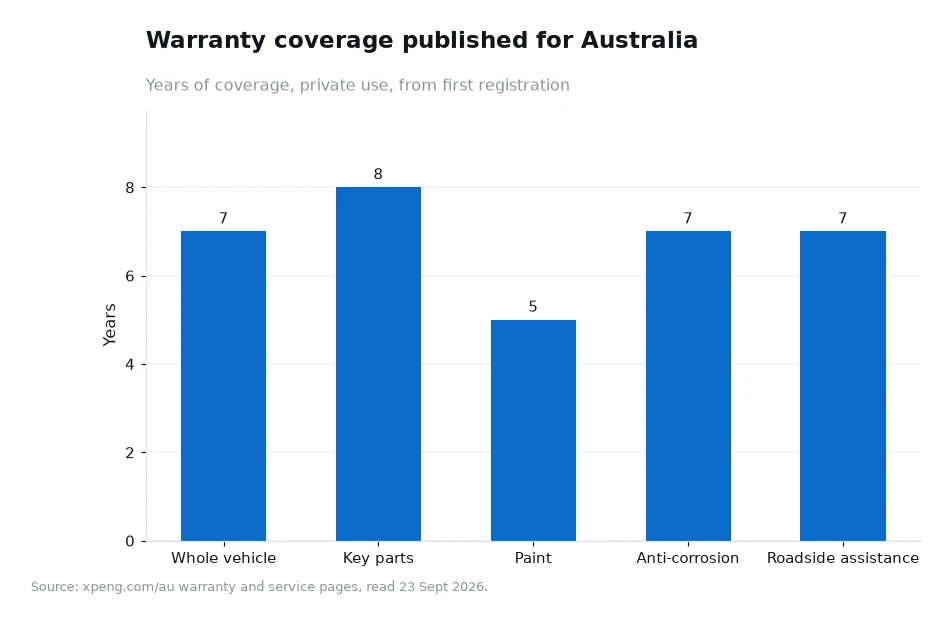
- Whole-vehicle cover runs 7 years, with 8 years or 160,000 km on key parts.
Five seats or seven: the question behind every other one
Most families shopping suv cars australia for a school run need five seats and a boot, and occasionally need seven. The distinction matters because a third row is either something you use weekly or something you fold flat and forget. The New G6 answers the first case with a conventional five-seat layout and a fastback body that keeps the cabin usable; the X9 answers the second with seven seats, active rear-wheel steering to make a long car manageable in car parks, and a third row that folds electrically with one touch when the seats are not needed. If you have ever spent a Sunday afternoon folding seats by hand, that one-touch function is worth more than its specification line suggests.
Boots, prams and the grocery run
The X9 publishes the harder numbers: cargo volume expanding to 2554 L, a submerged trunk design described as fitting seven suitcases with every seat occupied, and 30 m of forward obstacle detection feeding the air suspension so the ride settles before rough surfaces arrive. For the New G6, the manufacturer does not publish a cargo capacity figure, so treat any number you see quoted for its boot as unverified and check it with your own pram and shopping bags instead. That is not a dodge; it is the only test that predicts how the car behaves in a car park on a Saturday morning, because aperture shape and sill height matter as much as litres.
Doors, belts and the daily routine
The routine details decide whether a car becomes easy or irritating. Doors that open wide enough to lift a toddler into a restraint, belts that buckle without a hunt, and a boot that swallows a folded pram without a wrestling match. The New G6 pairs its adjustable front seating with a Xmart OS cockpit that supports customisable scene modes, which is a small convenience: set the car up for the school run once and the cabin can return to that configuration rather than your last weekend settings. The power-reclining Nappa leather seats carry the manufacturer's own qualification that availability varies by configuration, so confirm the trim level before you assume you are buying them.
Charging between the runs
A car that does two short trips a day rarely needs a public charger. Home charging through the Type 2 connector covers the school week neatly, and the published home features include plug-and-charge, a charging schedule and an anti-theft locking function. The schedule is the useful one for a household with a busy evening: let the car draw power inside an off-peak window rather than whenever it happens to be plugged in. Where the family also does long weekend trips, the published 10-80% charge window of 12 minutes turns a highway stop into a leg stretch rather than a stopover, and the charge flap on the right rear quarter panel means you reverse into the bay.
| Point | New G6 | X9 |
|---|---|---|
| Seats | Five-seat coupe SUV layout | Seven seats, one-touch electric fold-flat third row |
| WLTP range, published | Up to 525 km | Up to 580 km |
| Cargo | Not published on the model page | Expands to 2554 L |
| 10-80% charge | 12 minutes | 12 minutes |
| Scheduled servicing | Every 12 months or 20,000 km | Every 12 months or 20,000 km |
Car seats, cargo and the two-child problem
Two child restraints in the second row is where a five-seat layout earns or loses its reputation. The measurement that matters is not published, so take your own restraints to the test drive and fit them in the positions you will actually use, then check whether a third passenger can still access the middle seat belt without an argument. Behind that, the cargo question depends on the day: a single pram fits in most SUVs, a double pram plus a week of groceries is a different test, and the school bag pile is a third. The X9's published 2554 L with the third row folded flat turns that last problem into a non-event, and its one-touch electric fold means you can switch between carrying people and carrying things without leaving the driver's seat. Five seats plus a fastback boot is the simpler answer for most households, and it is worth being honest about which of the two you are.
Worked example: seven years of school runs
Illustrative arithmetic with assumptions stated, and it matches the chart below. Assume 15,000 km a year, which is a busy but not unusual family figure. Whole-vehicle cover is 7 years unlimited kilometres for private use, so 7 x 15,000 = 105,000 km sits inside that term, with the calendar rather than the odometer ending it. Key parts cover is 8 years or 160,000 km, whichever comes first: 8 x 15,000 = 120,000 km, short of the cap, so the calendar governs there too, and reaching 160,000 km within 8 years would need 160,000 / 8 = 20,000 km a year. Servicing runs every 12 months or 20,000 km, whichever comes first, so at this distance the annual visit always arrives first and the family books 7 scheduled services across 7 years. Drive 25,000 km a year, with a longer commute in the mix, and the 20,000 km trigger takes over, giving 160,000 / 20,000 = 8 services across the 8-year key parts window instead.
Frequently asked questions
How many seats does each model have?
The New G6 is a five-seat coupe SUV. The X9 is a seven-seat MPV with a one-touch electric fold-flat third row, and its cargo volume expands to 2554 L when the seats are folded. Both publish a 10-80% charge window of 12 minutes.
Does the manufacturer publish a boot capacity for the G6?
No. The Australian model page does not publish a cargo capacity figure for the New G6, so any number quoted elsewhere is unverified. The published cargo figure is for the X9, which expands to 2554 L, and the practical alternative is to load your own pram and bags at a dealer.
Try the seats, then decide
Take the pram, the school bags and a week of shopping to the test drive, and load the car the way you will load it every day rather than the way a showroom allows. Sit in the third row if you are considering the X9, and check whether an adult can use it for the length of trip you actually make. Then confirm the service interval and warranty terms for your variant, since cover details sit in the published manual. The X9 model page covers the seven-seat case, and Find a Dealer locates the nearest site for a proper loading test.
Seat counts, cargo volume, range figures and service terms quoted here are as published on the manufacturer's Australian website and read on 23 Sept 2026. The kilometre and service-count sums are my own illustrative arithmetic with assumptions stated, not manufacturer data, and WLTP range depends on conditions. [1]