A factory-direct plan turns a product requirement into a controlled sequence of supplier selection, quotation, approval, production, inspection, and delivery. It helps buyers see who makes each decision and what evidence is needed before money, tooling, or shipment is committed. Start with the product and destination, then build backward from the required delivery date.
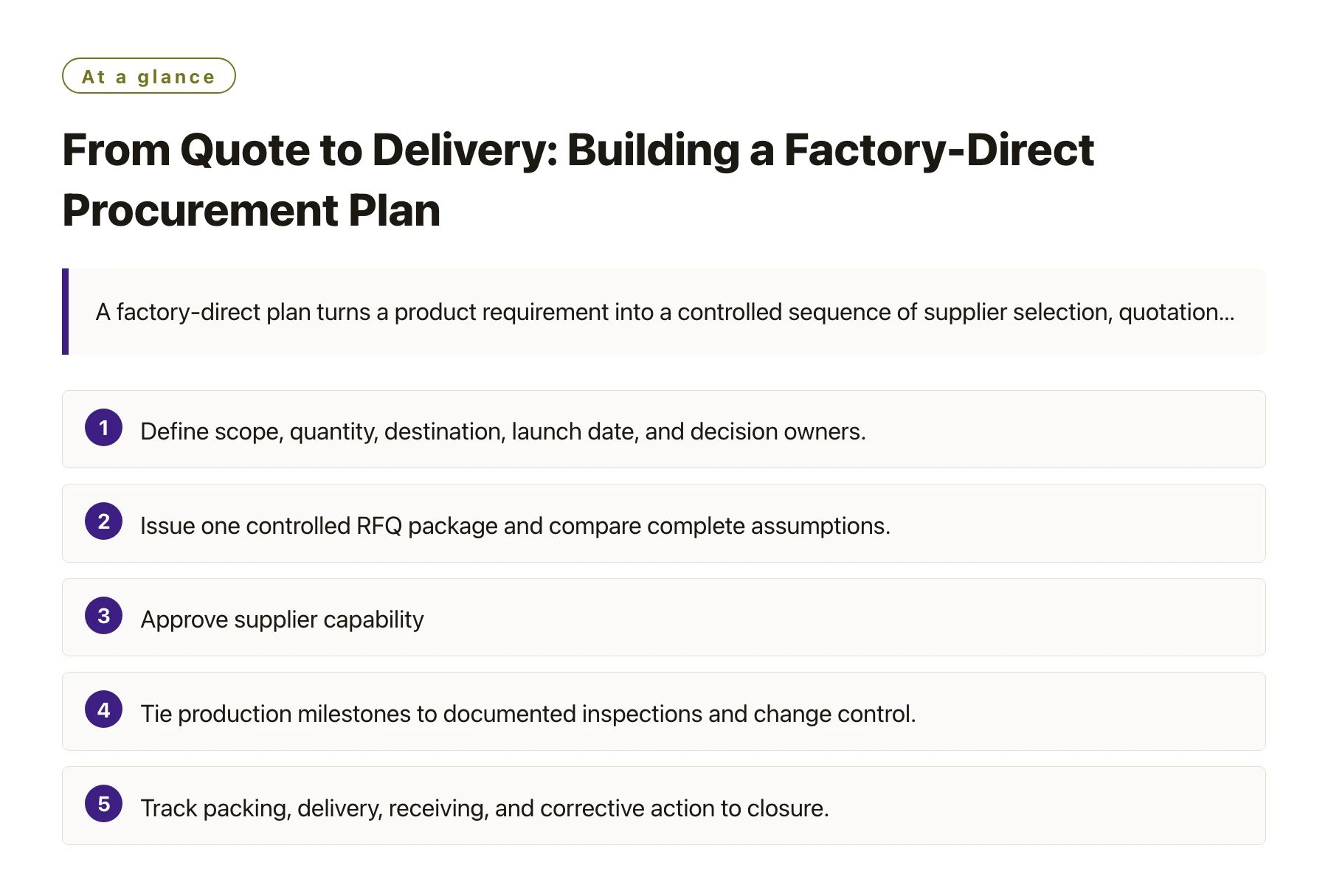
Key takeaways
- Define scope, quantity, destination, launch date, and decision owners.
- Issue one controlled RFQ package and compare complete assumptions.
- Approve supplier capability, sample, specification, and compliance evidence.
- Tie production milestones to documented inspections and change control.
- Track packing, delivery, receiving, and corrective action to closure.
Use a common room brief and product evidence matrix to compare supplier offers on the same basis.
1. Fix the project brief
State the product, intended use, specifications, variants, target quantity, market, delivery location, packaging, and launch date. Separate mandatory requirements from preferences and identify unresolved technical choices. A supplier cannot price accurately when a buyer is still changing dimensions, material, labels, or pack configuration.
Name decision owners for product design, compliance, purchasing, quality, finance, logistics, and final shipment release. Set response times and an escalation route so open questions do not sit between departments.
2. Plan sourcing and supplier qualification
Set the supplier profile needed: product experience, manufacturing process, capacity, export history, quality controls, language and time-zone coverage, and ability to provide required evidence. Decide whether the purchase needs a factory, trading company, or coordinated multi-supplier route, then document the rationale.
Use consistent screening questions and request business identity, site details, product examples, process map, subcontractors, and references appropriate to risk. Treat self-reported capacity as a starting point; verify critical information through documents, video or on-site review, and sample evaluation.
3. Issue a comparable request for quotation
Send the same specification, drawings, forecast, packaging requirements, destination, delivery basis, and schedule to every candidate. Ask for price tiers, tooling and sample charges, minimum order, lead time, payment milestones, warranty, spares, and exclusions. Require the vendor to identify any proposed substitutions separately.
Compare complete landed assumptions, not only unit price. Normalize currency, quantity, carton data, freight basis, duties, testing, and one-time charges. Record clarification answers in one log and apply them consistently to all suppliers.
4. Close technical and market requirements
Approve product configuration, materials, drawings, labels, instructions, packaging, required standards, and destination-market documents before order release. Assign qualified owners to interpret safety, regulatory, and engineering requirements. Avoid treating a supplier certificate or sample appearance as proof that every requirement is met.
Record any deviations and their impact on performance, compliance, cost, and delivery. Define what evidence is pending and whether purchasing may proceed conditionally. The project plan should contain explicit holds for high-risk missing approvals.
5. Control sample and production readiness
Identify sample type and version, factory, bill of materials, and test scope. Record measurements, visual approvals, open issues, and who signed each decision. If a sample is a prototype, state what must be reconfirmed on production-intent units.
Before mass production, confirm materials, work instructions, inspection criteria, approved suppliers, equipment, packaging, and capacity. Use a readiness review that lists each prerequisite, evidence, owner, and completion date rather than relying on a general verbal go-ahead.
6. Set milestones and quality checks
Create a schedule with purchase order, deposit, material readiness, first-off sample, in-process checks, final inspection, packing, document review, and shipment release. Define lot identity, sample selection, defect categories, pass criteria, corrective action, and reinspection. Align inspection timing with actual production stages.
Name the person who may accept deviations and the person who may release goods. Inspectors report findings; they should not invent missing product limits unless authority is explicitly delegated. Keep photographs, measurements, reports, and disposition records with the order.
7. Manage changes and communication
Maintain a change log for specification, drawing, factory, subcontractor, materials, cost, quantity, date, and packaging. Require supplier notice before implementing changes. Assess whether a change requires new samples, tests, document updates, cost approval, or a revised delivery plan.
Use one shared status report with decision, issue, owner, deadline, impact, and next update. Summarize phone or chat decisions in writing. Escalate schedule threats early and record recovery actions instead of allowing optimistic dates to persist without evidence.
8. Prepare logistics and receiving
Confirm shipment dimensions, carton marks, packing list, commercial invoice, certificates, origin documents, shipping term, insurance, customs broker, and delivery appointment. Assign responsibility for each document and check consistency across quantity, model, and party names before dispatch. ICC Incoterms® rules help define buyer and seller tasks, costs, and risks in goods delivery; name the selected rule and precise place in the contract. [1]
Plan receiving capacity, damage checks, shortage reporting, and storage conditions. Keep lot and serial references tied to inspection records. Close the purchase only after open claims, corrective action, invoices, and reusable lessons are recorded.
9. Use a managed sourcing partner when useful
A buyer coordinating several product categories or factories may need help with supplier communication, sample handling, inspection scheduling, and shipment coordination. Define the partner’s role, authority, reporting, fee basis, confidentiality, and conflict disclosures in writing.
Buyers evaluating js-sourcing.com can compare each proposed support task against the project plan and retain control of technical and regulatory decisions through named owners. Review performance at milestones and keep the decision trail visible to the buyer.
Sources
Frequently asked questions
What belongs in a factory-direct procurement plan?
Include scope, specifications, supplier qualification, quote comparison, sample approval, compliance review, production milestones, inspection, logistics, receiving, and decision owners.
When should a buyer approve a sample?
After the sample identity, specification, review method, open issues, and authority are clear, and before production relies on it as a reference.
How can a buyer compare factory quotes fairly?
Normalize product configuration, quantity, tooling, packaging, delivery basis, testing, payment, warranty, lead time, and exclusions.
Who should release goods for shipment?
A named buyer or quality authority should make the release decision using agreed criteria and documented inspection and document evidence.