AI-Generated Content Only: Why That Matters Legally
Provenance stops being an abstraction the moment a platform states what it contains. Crushon's compliance page, last updated 8 February 2025, says three things plainly: the content is AI-generated text, it depicts no real person, and the site does not produce images or video. For a reader deciding whether to trust an adult service, those three sentences do more work than any promise of quality.

Key takeaways
- Three specifics matter: AI-generated text, no real person depicted, and no images or video produced by the site.
- The statement is dated — 8 February 2025 — and a dated claim can be checked against behaviour.
- Report routes matter as much as claims: every content page carries a report option and the support address is public.
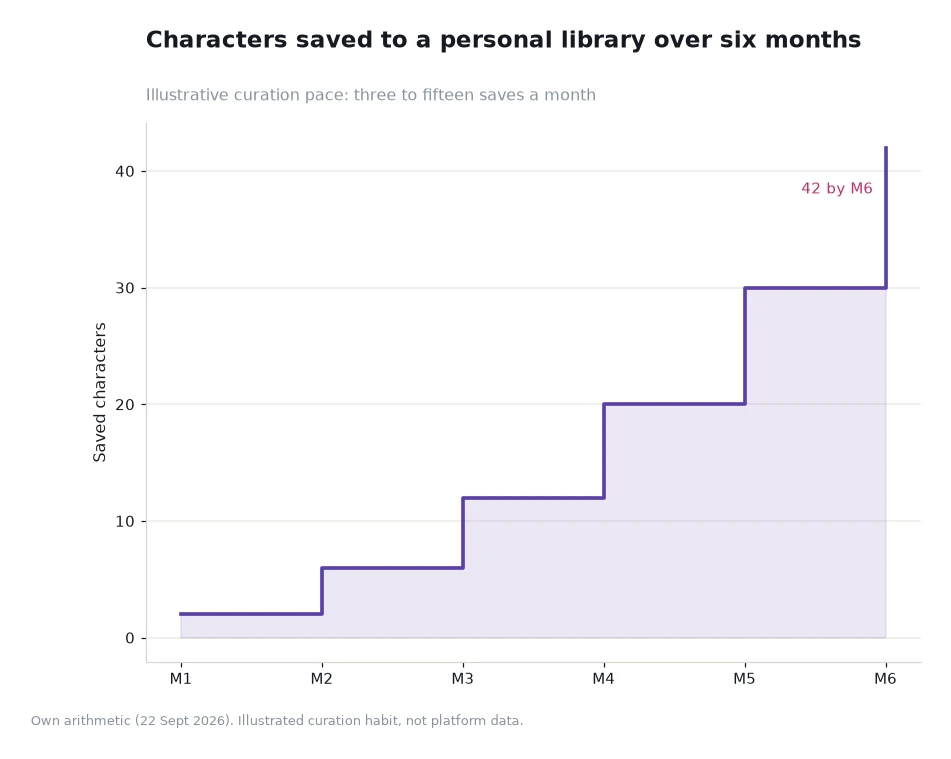
- At the illustrative pace a library reaches 42 saved characters in six months, and every one of them is text rather than media.
What the compliance page actually states
Compliance statements exist because jurisdictions require them, and that is exactly why they are informative: they are written to be legally accountable rather than persuasive. The Crushon statement, dated 8 February 2025, describes content that is generated by AI as text, states that no real person is depicted, and says the site does not produce images or video. Each clause narrows what the service is.
Read together, those clauses describe a product made of words about fictional characters. That is a much smaller claim than "adult platform" suggests at first glance, and it is the claim a reader should hold the service to. When something in the catalogue appears to contradict it, the contradiction is a matter for the report route, not a reason to revise the statement in your own head.
Why a text-only claim is comparatively easy to test
Claims about media are hard to verify because media is opaque: you cannot easily prove that a photograph depicts nobody. Claims about text are easier, because text can be read and judged. If the product is words, then the question of whether a real person is depicted reduces to whether the content describes real, identifiable individuals — and the statement answers that directly.
There is a second, subtler advantage. A service that produces no images or video removes a whole category of uncertainty about consent and likeness, because there is no likeness to obtain. That is not a legal opinion and it should not be read as one; it is simply the consequence of the platform's own description, and it changes how a Porn Chat AI service should be judged: by what its text does, rather than by what a media product might have produced.
How the claims are enforced
Statements are only as good as the mechanisms behind them. Two mechanisms are visible on the site. The first is per-page reporting: according to the content removal policy, every content page offers a way to flag it. The second is a public support address, which serves as both the reporting channel and the compliance contact point. Having both is a meaningful signal, because it means a report has a destination.
The rest is process. A separate complaints policy exists as an escalation route, and the community guidelines define the boundaries the platform describes when it says some limitations apply. None of that guarantees a particular outcome on any individual report, and the honest reading is that the mechanisms exist rather than that they are flawless. Readers who want to check the machinery can start with the 2257 statement and the content removal policy, both published in full.
| Claim | Where it appears | What it means for a reader |
|---|---|---|
| Content is AI-generated text | 2257 statement, updated 8 February 2025 | The product is words, not media |
| No real person is depicted | Same statement | Nothing in the catalogue claims to be a likeness of anyone |
| No images or video produced by the site | Same statement | Visual material is outside the product's scope by design |
| Content can be reported | Content removal policy | Every content page has a flag route |
| Some limitations apply | FAQ on the porn chat page | Unfiltered refers to tone, not to the absence of rules |
| A six-month library | Illustrative save habit | 42 saved characters, all of them text |
Worked example: what a library of text looks like over six months
Illustrative assumption: a reader saves characters gradually. Month one ends at 2 saves; additions of 4, 6, 8, 10 and 12 take the count to 6, 12, 20, 30 and 42 by month six. The monthly additions run from 4 to 12, inside a three-to-fifteen-a-month band.
Now attach the provenance claim to that library. Every one of the 42 items is a text-based character whose premise the platform describes as AI-generated, so the archive contains 42 pieces of writing about fictional personas and, by the platform's own account, no depictions of real people. For the reader this is simple and liberating: what you are keeping is text, and text is what the report route can act on if something in it breaks the guidelines. Nothing about the claim requires faith — it is auditable by opening the items you saved.
Checking provenance on an ai porn chat service
Three checks take under five minutes. Read the compliance page and note its date. Find the report option on any content page and confirm it exists. Then open one character and see whether the premise is a fictional persona, which is what the platform says it is. If all three check out, the provenance question is answered to the extent it can be answered from outside the service.
Repeat the check if the service changes materially, since statements are revised and the current one carries a specific date. Dating matters because it converts a claim into a record: a statement updated on 8 February 2025 describes the platform as it stood then, and a reader who checks again a year later is doing something more useful than trusting a memory of a policy page. That habit is the whole technique, and it costs less than reading the marketing copy once.
Frequently asked questions
What does the compliance statement say about real people?
It states that content is AI-generated, that no real person is depicted, and that the site does not produce images or video. Those are the platform's own words, dated 8 February 2025.
How would I report something that breaks the rules?
Use the report option on the content page itself, or write to the public support address, which the site lists for both reporting and compliance enquiries. A separate complaints policy provides an escalation path.
Does this mean anything goes?
No. The FAQ notes that some limitations apply under the platform's content and community guidelines, so unfiltered should be read as a description of tone rather than as an absence of rules.
Check the record, not the reputation
Read the dated statement, find the report route, and look at one character's premise yourself. Provenance is a question with a short answer, and the answer is available in three places on the site rather than buried in marketing language. Do the check once, note the date you did it, and revisit it only when something about the service changes.
Data and sources: the Crushon 2257 statement, last updated 8 February 2025, which describes content as AI-generated text depicting no real person[1], the content removal policy for the report route and support address, and the porn chat page FAQ for the note on guidelines, read 22 Sept 2026. The library progression is illustrative arithmetic. An 18+ adult audience is the only intended readership here.